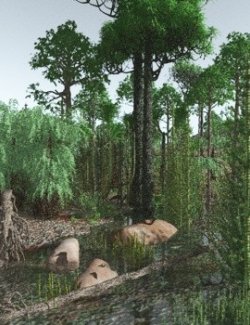
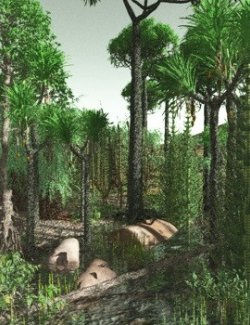
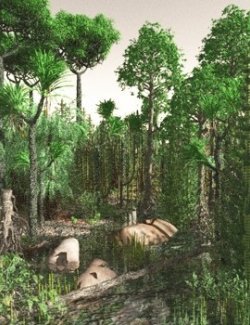
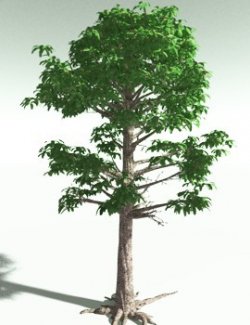
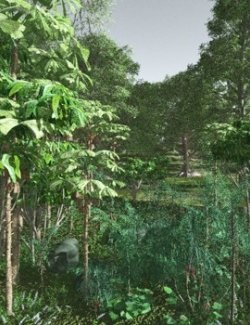
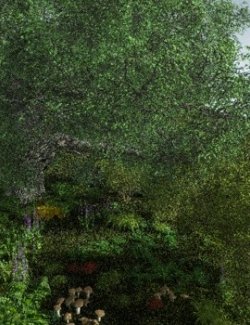
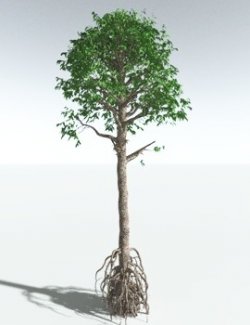
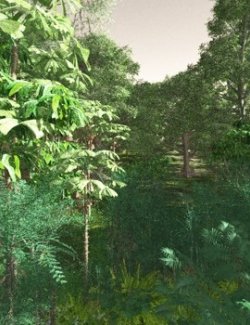
Name: Permian Biome
Biome packs are a collection of all the plants you need to satisfy a particular type of scene, containing both common and some rarer plants. Each plant species has several variations to allow for a diversity of scenes. Variation may include health, maturity, season (if appropriate), LOD and various other modifications.
Biome packs are discounted over the cost of the individual plants. All individual files are available in store separately.
Notes: The Permian period spanned 47 million years from the end of the Carboniferous Period 298.9 million years ago, to the beginning of the Triassic Period 251.902 Mya.
The Permian witnessed the diversification of the two groups of amniotes, the synapsids and the sauropsids (reptiles). The world at the time was dominated by the supercontinent Pangaea, which had formed due to the collision of Euramerica and Gondwana during the Carboniferous. Pangaea was surrounded by the superocean Panthalassa. The Carboniferous rainforest collapse left behind vast regions of desert within the continental interior. Amniotes, which could better cope with these drier conditions, rose to dominance in place of their amphibian ancestors.
The Carboniferous Rainforest Collapse would result in the replacement of lycopsid-dominated forests with tree-fern dominated ones during the late Carboniferous. The Gondwanan floristic region was dominated by Glossopteridales, a group of woody gymnosperm plants, for most of the Permian, extending to high southern latitudes. The ecology of the most prominent glossopterid, Glossopteris, has been compared to that of bald cypress, living in mires with waterlogged soils. The tree-like calamites, distant relatives of modern horsetails, lived in coal swamps and grew in bamboo-like vertical thickets. Early conifers appeared in the Late Carboniferous, represented by primitive walchian conifers, but were replaced with more advanced conifers later in the Permian. Permian conifers were very similar morphologically to their modern counterparts, and were adapted to stressed dry or seasonally dry climatic conditions. The increasing aridity, especially at low latitudes, facilitated the spread of conifers and their increasing prevalence throughout terrestrial ecosystems.
Included in this Package:
- Complete plant solution for this type of biome.
- 12 plant species.
- Maturity variations for each plant.
- Health variations for each plant.
- Seasonal variations where appropriate.
- Other variations for some plants.
- Discounted price.
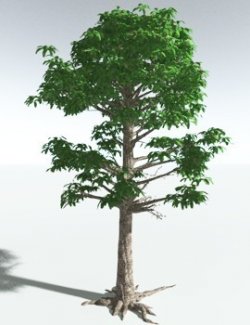
Plant Species Included:
- Glossopteris Communis
- Walchia Piniformis
- Cordaites Ludlowi
- Noeggerathia Foliosa
- Pseudoctenis Eathiensis
- Alethopteris Serlii
- Baiera Gracilis
- Bjuvia Simplex
- Lepidodendron Obovatum
- Sigillaria Ovata
- Arthropitys Bistrata
- Cladophlebis Roylei
All models can be switched between High Poly for close up renders, image or video production, and Low Poly for distant renders, use as game assets, or in real-time applications. All materials in this package are certified PBR compliant and have been tested in Unity and Unreal. Any reasonable modification available upon request. No charge to existing customers of the product, please contact via site mail.
Included are two versions of each model, a full and a LITE version. Both versions give good results, but the full version is more accurate and better for hero or close up renders. The LITE version is intended mainly for mid or distant renders or eco use, or use on low end PCs.
EVERYPlant has a mission ... which is to model every plant species in the world (plus some extinct, fantasy and sci-fi variations as well)! Okay, maybe not EVERY plant! If you don't see it in our store, please get in contact; we have thousands of species on file awaiting upload.
Software: Vue 2024