Kage MedTech – Cyberpunk Medical Props for Daz Studio
When chrome meets flesh, someone has to keep it running. Kage from Neo-Kyoto, a wholly owned subsidiary of the Xanathon Corporation, equips the clinics of tomorrow – and, unofficially, every back-alley streetdoc who can get hold of a crate that fell off a truck. Six wireless medical devices for the age of cyberware – implant testing, neural diagnostics, port scans, vital signs with implant load, nanite infusion and bioprinted replacement tissue – plus the furniture to treat patients on: a patient chair, a reclining diagnostic chair and a treatment couch. Every unit charges inductively, so there is not a single cable in the room. Rumour has it that each device quietly mirrors its patient data to a Xanathon server somewhere in orbit – but that is surely just paranoia …
Two looks in one package: the spotless Clinic finish for corporate hospitals and the battered Street finish for the streetdoc's back room.
WHAT'S INCLUDED
• Implant Bench Tester KM-IB1 – test bench for cyber limbs. The patient sits at the open end and lays the arm (it stays attached) into padded V-rests; a scan arch with louvred light emitters runs over the full length. Forearm rest and hand rest slide along a centre rail.
• BCI Neuro-Analyzer KM-BN2 – console with a contact-free scan halo for brain–computer interfaces on a swivelling, height-adjustable arm. 8-channel EEG display with sync ring.
• CyberJack Diagnostic KM-CJ3 – port diagnosis unit with a pistol-grip hand scanner standing in an inductive charging dock, and a floating display on a hinge.
• Vital Monitor KM-VM4 – 24-inch patient monitor on a workstation base: ECG, pleth, respiration, SpO₂, NIBP, temperature – plus neural resonance, reflex timing and implant load. Second display, touch fields and a pivoting contact-free sensor head.
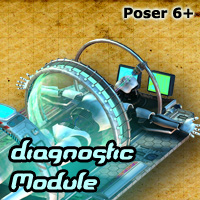
• Nanite Infusion Unit KM-NI5 – the forearm rests in a padded tube with a viewing window; the infusion happens invisibly inside. Three cartridges of metallic nanite suspension under a lift-off glass hood.
• Synth-Tissue Bioprinter KM-BP6 – glass-door print chamber with an XYZ gantry, a print head with two bioink cartridges and white curing light bars. Inside: a freshly printed human ear resting in support gel in a culture dish.
• Patient Chair – swivel chair on a five-star base with a slim gas-lift column, tall backrest with three padded bolsters, flip-up armrests and an adjustable headrest.
• Diagnostic Chair – reclining treatment chair on a column with a lift: backrest, leg rest and fold-back armrests, adjustable headrest and a display on a swing arm beside the patient's head.
• Treatment Couch – couch with sculpted side rails on a pedestal; the back section rises with its own rails and a head pillow, and the lying surface lowers far enough to sit down on comfortably.
• A rolling stand for every device (devices load on their stands; table use see below)
• A curved, reflective studio backdrop
• A type plate with technical data on the back of every device
All devices, the furniture and the backdrop sit under one common root node, so the set loads in one go. Each device and each piece of furniture is its own group under that root – move, hide or delete them individually.
MOVING PARTS
The devices are built for posing. Moving parts are separate nodes with limits that match their mechanical stops:
• Implant Bench Tester: the scan arch runs along its rails over the full length; forearm rest and hand rest slide along the centre rail
• BCI Neuro-Analyzer: arm swivels without limit, lift carriage moves up and down, elbow and halo tilt
• CyberJack Diagnostic: display tilts on its hinge; the hand scanner is a free node – take it out of the dock and put it in a character's hand
• Vital Monitor: monitor tilts, sensor head swivels and tilts
• Nanite Infusion Unit: the glass hood is a free node – lift it off the cartridges and set it down anywhere
• Synth-Tissue Bioprinter: door opens up to 100 degrees, gantry moves in X and Y, print head moves up and down
• Patient Chair: seat height 42–55 cm, swivels all the way round, backrest tilts back 15 degrees, armrests flip up, headrest slides up 6 cm
• Diagnostic Chair: height adjustable by 20 cm, backrest reclines up to 50 degrees, leg rest raises to horizontal, armrests fold back 90 degrees, headrest slides 6 cm up or down, display arm swings to the side
• Treatment Couch: lying surface 50–78 cm high (low enough to sit down on), back section rises up to 70 degrees
All other parts are locked, so the Parameters pane only shows what actually moves.
STAND OR TABLE
Every device loads standing on its own rolling stand, at a working height that fits its use:
• Implant Bench Tester, BCI Neuro-Analyzer, CyberJack Diagnostic, Vital Monitor: 79 cm (patient seated at the bench tester)
• Nanite Infusion Unit: 58 cm – the arm tube sits at seated elbow height
• Synth-Tissue Bioprinter: 87 cm – the culture dish is at about 1.05 m, easy to watch while standing
To use a device on a table or counter instead, hide (or delete) its stand node and set the Z translation of the device's body node to 0, then place the device on your table. For the Nanite Infusion Unit use a low treatment table of about 58 cm; on a standard 75 cm desk the patient's arm would be too high.
CLINIC AND STREET
• Clinic (default): clean white housings, gunmetal trim, cyan accents.
• Street: the same equipment after years of hard use in a streetdoc's back room – old and worn, but kept clean (no streetdoc gambles with a patient's life). Yellowed housings, scratches where hands and instruments touch, chipped corners and edges down to the primer, worn-through paint on base plates and couch rails, rubbed-off buttons and lettering, sat-in chair cushions and a worn lying surface on the couch. Three displays are cracked but still running: the Vital Monitor's screen is shattered from a corner impact, the CyberJack scanner and the bioprinter each have a crack. Load it as a material preset; geometry and node structure stay identical, so you can switch at any time, even after posing.
DIMENSIONS (W x D x H)
• Implant Bench Tester 98 x 40 x 47 cm, BCI Neuro-Analyzer 98 x 42 x 91 cm (arm in rest pose), CyberJack Diagnostic 38 x 32 x 32 cm, Vital Monitor 66 x 35 x 69 cm, Nanite Infusion Unit 73 x 25 x 47 cm, Synth-Tissue Bioprinter 42 x 34 x 42 cm
• Patient Chair 61 x 62 x 125 cm, Diagnostic Chair 89 x 137 x 126 cm (with display arm and leg rest), Treatment Couch 73 x 208 x 80 cm
• About 102,300 polygons for the complete set (devices, rolling stands, furniture and backdrop)
MATERIALS AND TEXTURES
• Iray Uber materials with PBR maps; displays, labels and type plates are textures with normal maps (no extra polygons)
• Displays, neon lines, light bars and status lights are emissive surfaces; adjust their brightness in the Surfaces pane (Emission)
• Glass, the nanite hood and the bioprinter's support gel use Iray refraction
• No lights or cameras are included. The glossy screens, glass and metal surfaces look best with an HDRI or a few lights to reflect.
COMPATIBILITY
• Daz Studio 4.24, NVIDIA Iray
• No figures, plugins or other products required
• Not set up for Filament or 3Delight
INSTALLATION
• Daz Install Manager (recommended): copy the ZIP unchanged (do not extract or rename it) into your DIM download folder ("Package Archive", DIM: gear icon > Advanced Settings > Downloads), restart DIM and install it from the "Ready to Install" tab.
• Manual: extract the contents of the "Content" folder into your Daz content library (e.g. "My DAZ 3D Library"). If the product does not show up in Smart Content, use Content DB Maintenance > Re-Import Metadata.